TWO FREE TOOLS TO MAP HOW AI IS REALLY BEING USED ACROSS YOUR ORGANISATION, AND PLAN WHAT CAPABILITY, GUIDANCE AND SUPPORT YOU NEED NEXT.

Where is your organisation really at with AI?

Screenshot 2026-10-15 at 12.12.50 pm
sam-altman
"AI won't replace humans. But humans who use AI will replace those who don't."

Sam Altman, CEO, OpenAI
WHY THIS MATTERS NOW

AI adoption happens gradually, then becomes a governance issue.

Most organisations have an AI policy. Fewer know how AI is actually being used across their teams.

Some people are all in. Some are steering clear. Some are quietly using tools nobody signed off on. These two tools help you see the full picture, so your next move is based on what’s really happening, not what the policy says should be happening.

THE GOVERNANCE CHALLENGE

Governance depends on shared capability

AI governance ultimately depends not only on rules, but on the capability and judgement of the people applying them.
Across many organisations, three dynamics are already emerging.

AI is already embedded

Staff are using AI tools to draft advice, analyse information, and prepare documentation, whether or not a formal strategy is in place.

Practice varies across teams

Without shared standards, teams develop different habits around verification and judgement, making consistent oversight difficult.

Accountability remains human

When AI-assisted work contains errors or omissions, responsibility still sits with the professionals who relied on it, and the organisation within which it was used. 

Bianca NEW BW
"At a time when information environments are already saturated and fast-moving, this shift increases both opportunity and risk. Without shared understanding, organisations may rely on tools without fully appreciating their limitations. Over time, that can weaken consistency, accountability and professional standards. For this reason, I believe AI literacy must be understood as a governance capability."

 Bianca Raby, Founder & CEO, Oppida 

Inside the guide

What is inside?

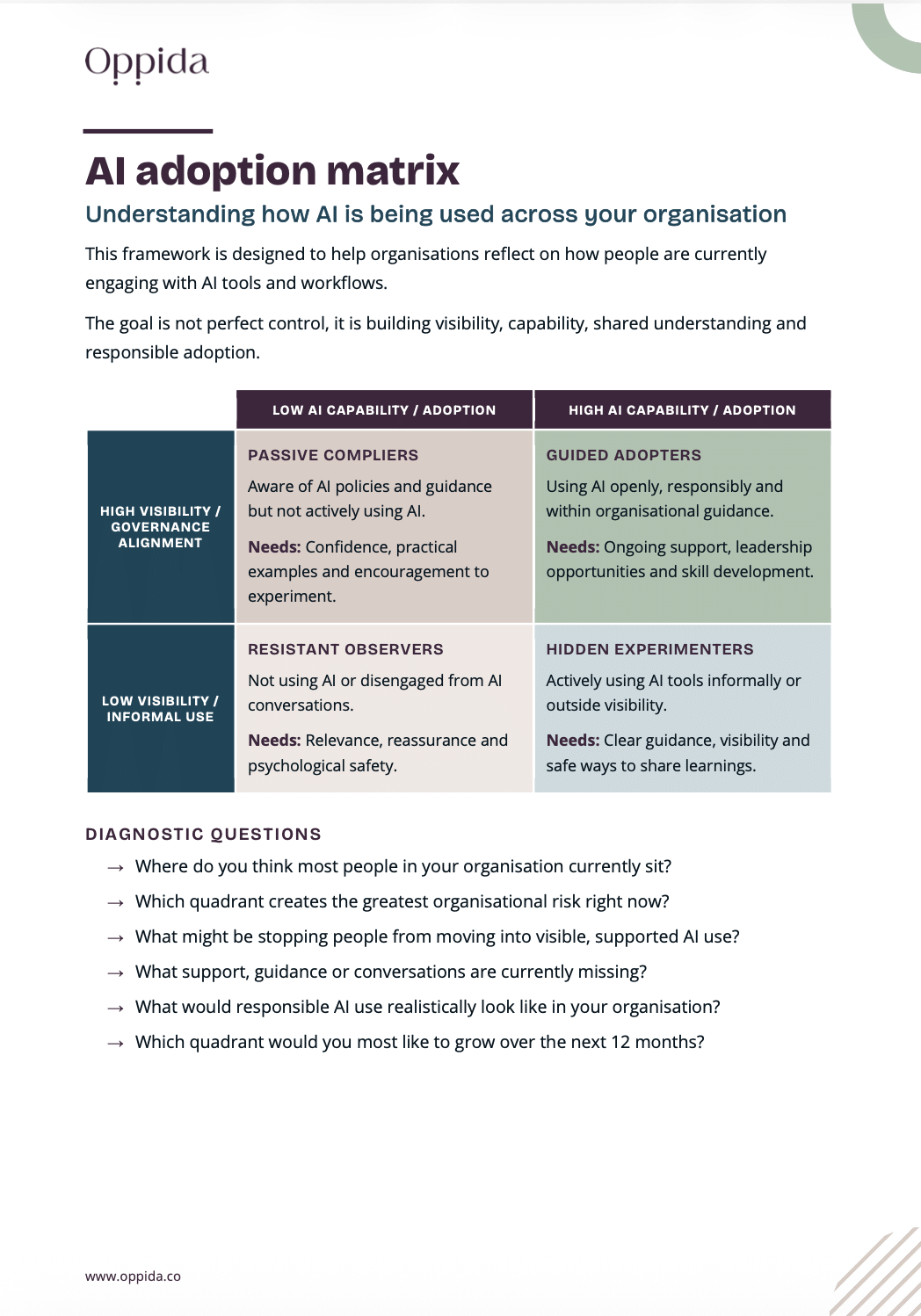
The AI adoption matrix

Map where people, teams or roles sit across four groups: passive compliers, guided adopters, resistant observers and hidden experimenters. Six discussion questions help you work out where your biggest risk sits.

The AI workforce capability maturity map

Track five dimensions across four stages, from individual productivity to work redesign. The five dimensions are how AI is used, AI literacy, critical thinking, governance and ethics, and learning and capability. Score where you are now and where you want to be, then plan your next move.

Ready to understand what AI governance now requires from leaders?